Invasive species education empowers students to become thoughtful stewards of their local environment. By learning how invasive plants and animals spread and how to prevent it young people gain practical skills they can apply at home, at school, and outdoors.
CSISS supports teachers and educators with age-appropriate resources, local knowledge, and hands-on learning opportunities across the Columbia Shuswap region.
CSISS in partnership with the Invasive Species Council of BC can provide educational resources and activities that fit well in the prescribed BC Learning Objectives.
Classroom & Outdoor Learning Opportunities
Invasive Species Education Sessions
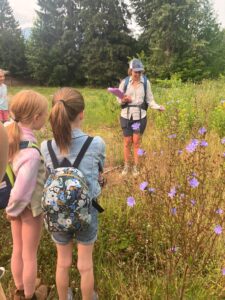
An invasive species session
Biodiversity and Invasive Species Classroom Visit
CSISS offers interactive, age-appropriate classroom presentations that introduce students to what invasive species are, how they spread, and why they matter in the Columbia Shuswap region. Sessions are designed to be engaging and accessible, using real local examples to help students understand the connection between everyday actions and environmental impacts.
Through discussion, visuals, and hands-on activities where possible, students learn how invasive plants and animals affect native species, habitats, recreation, and community spaces. Presentations also focus on practical prevention behaviours — such as cleaning footwear and gear, staying on trails, never releasing pets or plants, and choosing local firewood — empowering students with simple actions they can take at home and outdoors.
Weedpull Field Trips
Organize a weed pull or restoration event with your class to take action and protect our native biodiversity. Invasive species and native biodiversity are important themes tied to the BC curriculum. Take your class or youth group outside to identify invasive plants/species, and organize a weed pull or restoration event in the Columbia Shuswap region. CSISS staff will help you find a site for your event, provide you with work gloves and some tools, and a staff person to help guide the field trip.
Content is tailored to suit different age groups and learning levels, and can be adapted to align with classroom topics such as ecosystems, biodiversity, stewardship, and place-based learning. The goal is to build curiosity, confidence, and a sense of responsibility, helping students see themselves as active caretakers of their local environment.
Teacher Training – Pro D
CSISS now offers Pro-D Day Teacher Training. Find out what invasive species are threatening your local biodiversity, what you can do to help, and learn how to link invasive species to your classroom and tie into the curriculum. Pro D-Day Training comes complete with power point, hands-on activities and an outdoor plant ID session. Training sessions are suitable for elementary, middle and secondary school classes and sessions run approximately a half day in length. Please contact CSISS to book your Pro-D Day session.
To view our workshop activity sheet click here: Invasive Species Workshop Follow Up Activities
For more information, please CONTACT US.
Educational Resources:
Invasive Species Council Activity Sheets
- On the ISCBC Education website there are activity sheets for Primary, Elementary, Intermediate and Secondary grade levels!
- See the Youth Games and Activities Page for more information.
- Resource for Students- Thanks for the suggestion Hannah!
Activity Books
- Invasive Species in Our Waters
- Invasive Species on Our Landscapes
- ISCBC Invader Crusaders
- Bionic Bob- Coloring Book
Do you have a classroom pet?
Ensure your classroom pet isn’t an invasive species and never release your unwanted pets into the wild. Some exotic pets are able to thrive and reproduce in their new environment. Once established, they can take over their new habitat, reducing native populations and changing the structure of the ecosystem.
British Columbia is now home to several introduced invasive pet and plant species, including:
- Red Eared Slider Turtle
- American Bullfrog
- Goldfish
- Eurasian Watermilfoil
- Parrot Feather
- European Rabbit
- Brazilian Elodea
- Koi Carp
You can help! Don’t Let It Loose!
Do you use animals for scientific classes?
American bullfrogs (often used as dissection animals) are one of the world’s 100 worst invaders! The Columbia Shuswap does not have these invaders yet, please do not use them or release them to the wild.
Why Teach About Invasive Species?
Invasive species provide a powerful real-world learning context for:
- Environmental stewardship and place-based learning
- Biodiversity and ecosystem health
- Human impacts on natural systems
- Problem-solving and community responsibility
Students also become important messengers, sharing what they learn with families and peers.